Hyperbaric Oxygen Therapy for Decompression Sickness
Decompression sickness - "the bends" - happens when nitrogen bubbles form in the body after surfacing too quickly from a dive. Recompression in a hyperbaric chamber is the definitive treatment.
What this means for you
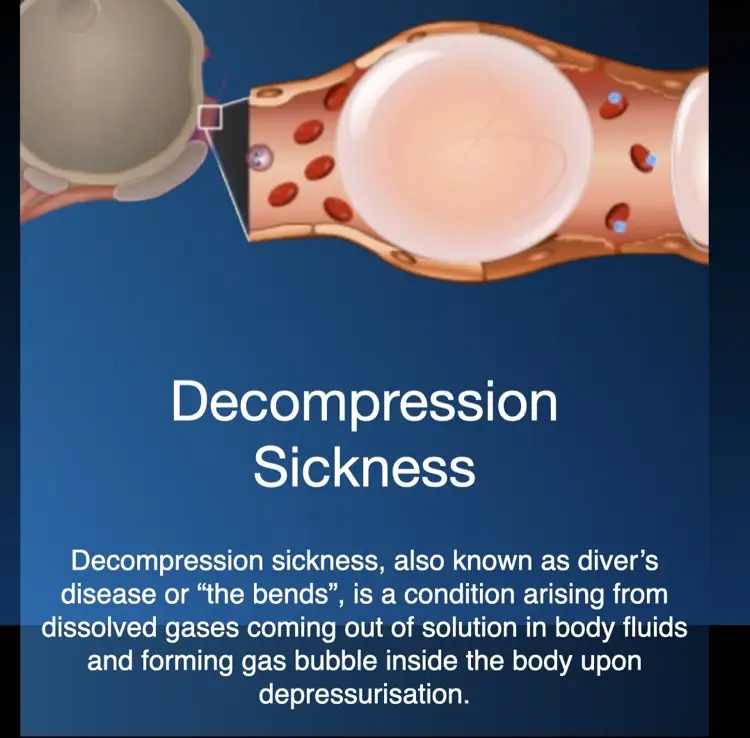
What is decompression sickness?
When you breathe compressed air while diving, extra nitrogen dissolves into your blood and tissues under the higher pressure. If you come back to the surface too quickly, that nitrogen does not have time to leave gently - instead it forms bubbles, much like opening a fizzy drink too fast. These bubbles can block small blood vessels and irritate tissue, causing what divers call the bends.
What are the symptoms?
Symptoms usually start within minutes to hours of a dive. They range from aching joints, unusual tiredness and an itchy or mottled skin rash, to more serious nervous-system problems such as numbness, weakness, difficulty walking, dizziness, or trouble with the bladder. Chest pain and breathlessness can also occur. Any unusual symptom after diving should be taken seriously.
How can hyperbaric oxygen help?
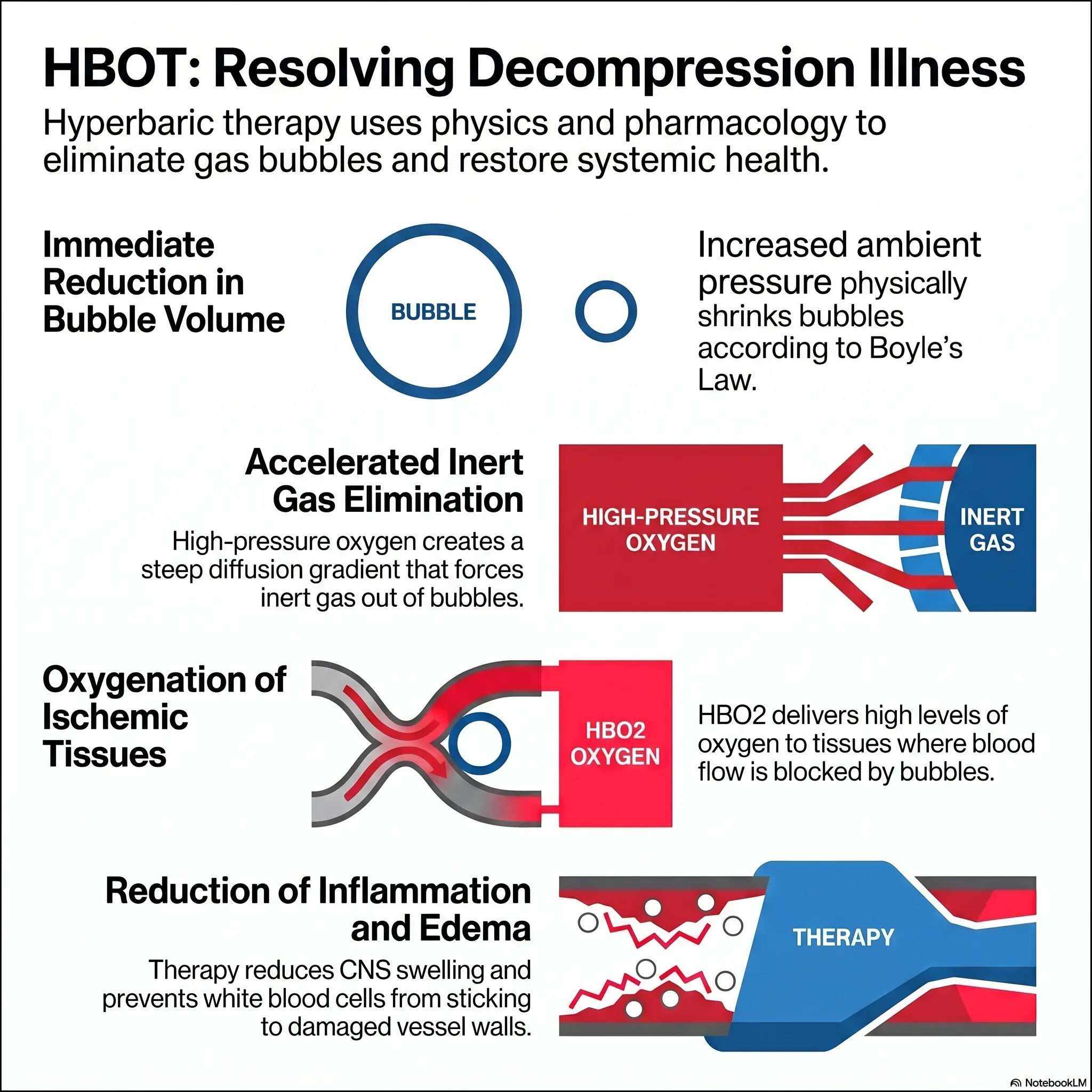
The treatment is recompression in a hyperbaric chamber. Raising the pressure around you shrinks the nitrogen bubbles so blood can flow past them again. At the same time, breathing pure oxygen washes the leftover nitrogen out of your body and floods injured tissue with the oxygen it was starved of. The pressure is then reduced slowly and safely under supervision.
What to expect
Treatment follows an established recompression schedule in the chamber and is started as early as possible. Even when there has been a delay, recompression can still help. The number of sessions depends on how you respond.
Is it safe?
Hyperbaric oxygen is generally well tolerated. The most common sensation is pressure on the ears during compression, much like descending in an aeroplane. Serious side effects are uncommon. You can read more on our risks and side effects page.
Watch
 Decompression Sickness (English)
 Dekompressiesiekte (Afrikaans)
 For Patients: Decompression Sickness (UHMS 07)
This page is general health information and does not replace advice from your own doctor. Whether hyperbaric oxygen is appropriate depends on your individual circumstances.
Clinical summary
Indication
Decompression sickness (DCS), part of the spectrum of decompression illness, is a primary indication for hyperbaric oxygen (HBO) therapy under the Undersea & Hyperbaric Medical Society (UHMS). Recompression on oxygen is the definitive treatment and should not be delayed.
Pathophysiology
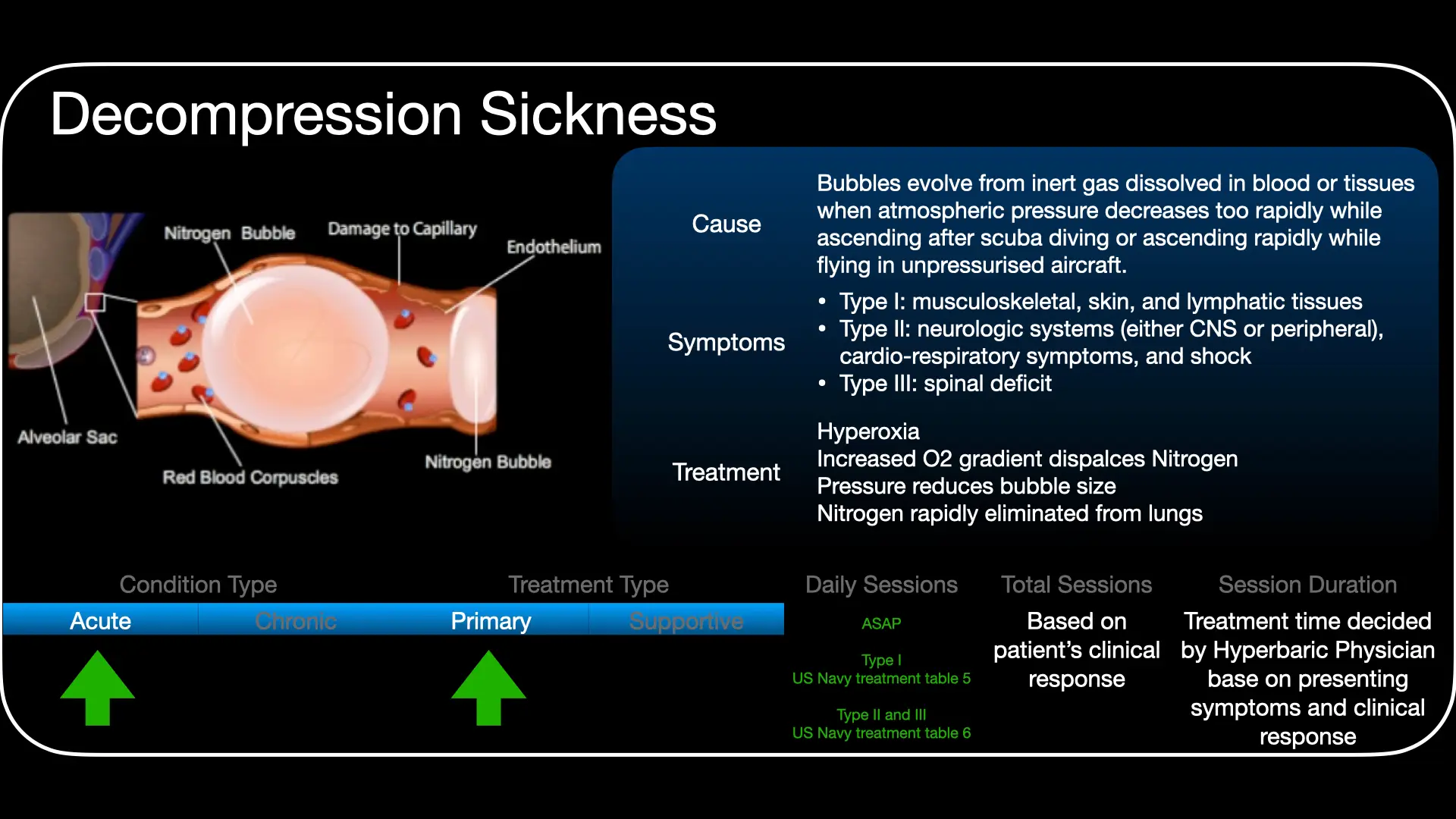
Breathing gas at depth increases dissolved inert gas (usually nitrogen) in blood and tissues per Henry's law. If ascent outpaces safe off-gassing, supersaturation drives bubble formation in venous blood and tissues. Bubbles cause direct mechanical obstruction, endothelial injury, complement activation, platelet aggregation and a secondary inflammatory cascade. Clinically this is divided into Type I (musculoskeletal pain, cutaneous, lymphatic) and Type II (neurological, inner-ear, cardiorespiratory "chokes") disease; arterial gas embolism may coexist.
Why recompression works
Recompression applies Boyle's law - increased ambient pressure reduces bubble volume and restores perfusion - while 100% oxygen creates a steep inert-gas washout gradient that accelerates nitrogen elimination and re-oxygenates ischaemic tissue. HBO also limits the secondary inflammatory and oedematous injury. Together these make recompression both mechanically and physiologically corrective.
Immediate management & first aid
- High-flow 100% surface oxygen as early as possible; this alone can improve symptoms and speed off-gassing.
- Keep the diver supine; provide fluids (oral or IV) to counter dehydration and haemoconcentration.
- Do not delay referral for "mild" symptoms - neurological DCS can evolve. Arrange urgent transfer to a recompression facility and liaise with a diving-medicine resource.
Recompression approach
Definitive treatment is recompression on 100% oxygen using a recognised table - most commonly a US Navy Treatment Table 6 (initial depth equivalent to 2.8 ATA), with extensions or deeper tables for incomplete response or severe presentations. Repetitive (follow-up) treatments are given until the patient plateaus clinically. Recompression remains worthwhile even when presentation is delayed.
Evidence base
Recompression for DCS is long-established standard of care, grounded in physical principles, extensive operational diving-medicine experience and case series; a randomised comparison against no recompression is neither ethical nor feasible. The Cochrane review of decompression illness (Bennett et al, 2012) confirms recompression as the accepted standard while noting there is no randomised trial of recompression itself. Among adjuncts, an NSAID (tenoxicam) and heliox tables can reduce the number of recompressions required but do not change recovery odds. A 2025 review of the field (Fairhead) identified only two randomised trials in total - underlining how sparse trial-level evidence is, and why the indication rests on standard-of-care rather than trial-level proof.
Where trial evidence does exist, it concerns table selection rather than whether to recompress: a single-blind randomised trial in mild DCS (Banham et al, 2022) found a shorter monoplace table achieved resolution in fewer treatments than a modified US Navy Table 6, with equivalent final outcomes. Across all presentations, the consistent clinical message is that time to recompression is the strongest modifiable predictor of outcome - treat as early as possible, but do not withhold treatment when presentation is delayed, as benefit is documented hours to days later.
Bottom line: the case for recompressing symptomatic DCS rests on physiology, universal diving-medicine practice and consistent observational outcome rather than on randomised trials (of which there are essentially none for the treatment itself). It remains the definitive, time-critical treatment.
Talks & chapter reviews
Recorded talks and textbook-chapter reviews on this indication:
 UHMS Indications, Ch. 07 — Decompression Sickness
 Jain's Textbook, Ch. 11 — Decompression Sickness
 Decompression Illness — A Comprehensive Overview
 Monoplace Chamber Treatment of Decompression Illness
 HBOT for Decompression Sickness (overview)
 HBOT for Decompression Sickness & Arterial Gas Embolism
Key references
- Undersea & Hyperbaric Medical Society. Hyperbaric Oxygen Therapy Indications, 15th ed (2023) - Decompression Sickness (Ch. 7).
- Vann RD, Butler FK, Mitchell SJ, Moon RE. Decompression illness. Lancet. 2011;377(9760):153-64.
- Bennett MH, Lehm JP, Mitchell SJ, Wasiak J. Recompression and adjunctive therapy for decompression illness. Cochrane Database Syst Rev. 2012;(5):CD005277.
- Banham N, Hawkings P, Gawthrope I. A prospective single-blind randomised clinical trial comparing two treatment tables for the initial management of mild decompression sickness. Diving Hyperb Med. 2022;52(2):85-91.
- Fairhead T. Recompression and adjunctive therapies in DCI management in divers: a review of RCTs. Undersea Hyperb Med. 2025;52(4):607-15.
- Mitchell SJ, Bennett MH, Bryson P, et al. Pre-hospital management of decompression illness: expert review of key principles and controversies. Diving Hyperb Med. 2018;48(1):45-55.
- Undersea & Hyperbaric Medical Society. UHMS Best Practice Guidelines: Prevention and Treatment of Decompression Sickness and Arterial Gas Embolism. 2011.
- US Navy Diving Manual - Recompression Treatment Tables (Treatment Table 6).
Under Pressure: 5 Surprising Truths About "The Bends" You Didn't Learn in Scuba Class
There is a violent biological threshold where the air we breathe ceases to be a life-giving gas and begins to behave like a physical predator. In a physiological instant, the blood undergoes a phase-shift where dissolved nitrogen tears through the blood-tissue barrier, turning the circulatory system into an effervescent, hostile environment. This is decompression sickness (DCS), the core component of what clinicians call decompression illness (DCI).
The term "DCI" is a necessary umbrella in the medical world because, in the heat of a clinical emergency, it is often impossible to distinguish between DCS (gas bubbles forming from tissue) and arterial gas embolism (AGE), where gas is forced into the bloodstream due to lung trauma. Whether the bubbles originated in the fat cells or were blasted through the alveolar walls, the result is a systemic crisis. While your open-water certification may have taught you that "the bends" is a deep-sea diver's nightmare, the modern clinical reality is far more pervasive, counter-intuitive, and strange.
1. It's not just for divers (the altitude and space factor)
The most fundamental truth of DCI is that it is a "pressure-change disease", not a "water disease." We live in a state of equilibrium with the weight of the atmosphere; when that weight vanishes too quickly, the physics of supersaturation take over. This means the bends can strike in the vacuum of a space walk, during the sudden depressurisation of a hyperbaric chamber, or in an unpressurised aircraft.
There is a specific physiological "ceiling" for this phenomenon. Without a preceding dive to saturate the tissues with nitrogen, the threshold for DCS in unpressurised flight begins between 18,000 and 20,000 feet. However, the medical response to altitude-induced DCS offers a surprising twist that differentiates it from diving accidents: normobaric oxygen - 100% oxygen at ground level - may be considered "definitive treatment" for altitude DCS if neurological symptoms are absent.
"DCI may occur when ambient pressure is reduced during ascent from a dive, depressurization of a hyperbaric chamber, rapid ascent to altitude in an unpressurised aircraft or hypobaric chamber, loss of cabin pressure in an aircraft... and during space walks."
2. The "safe" depth is shallower than you think
Scuba training often leaves students with the impression that decompression risk is a concern reserved for the "technical" crowd - those exploring deep wrecks or plunging beyond 100 feet. The clinical data suggests a much more unforgiving reality. While the established threshold for DCS in compressed gas diving is approximately 20 feet (6 metres), its more lethal sibling, arterial gas embolism, ignores these boundaries entirely.
AGE, caused by pulmonary barotrauma (lung over-expansion), can occur in as little as one metre of water. A single panicked breath held during a rise from the bottom of a backyard swimming pool is physically sufficient to rupture lung tissue and send gas into the arterial system. This creates a "false sense of security" in shallow environments. Whether you are at 60 feet or just three, the physics of pressure are active and potentially lethal.
3. Your body treats bubbles like a physical injury
For decades, the popular understanding of "the bends" was purely mechanical - a bubble acts like a "cork" in a pipe, blocking blood flow. Modern research reveals a far more aggressive pathophysiology. The body does not see these bubbles as mere air; it perceives them as a traumatic, foreign intrusion, triggering a systemic "inflammatory storm."
When bubbles form, they cause immediate mechanical disruption of tissue, but the secondary effects are often more damaging. They trigger the coagulation cascade, causing blood to clot inappropriately, and induce "endothelial dysfunction" - a state where the lining of the blood vessels becomes compromised, leading to capillary leakage and ischaemic tissue.
Furthermore, we now know that risk isn't distributed equally. Clinicians use the "MEDSUBHYP score" to identify high-risk patients; factors such as being over the age of 42 or experiencing back pain are significant prognostic indicators of a worse neurological outcome.
"Recent evidence suggests that circulating microparticles may play a pro-inflammatory role in DCS pathophysiology... Microparticles initiate decompression-induced neutrophil activation and subsequent vascular injuries."
This inflammatory response explains why symptoms often persist or evolve even after the physical bubbles have been crushed by a recompression chamber. The bubbles may be gone, but the "microparticle" storm and the resulting cellular damage require repetitive hyperbaric treatments to resolve.
4. First aid wisdom is changing (the end of Trendelenburg)
As medical consensus evolves, several "common sense" first-aid practices have been retired. For years, divers were taught the Trendelenburg position - lying the patient on their back with feet elevated and the head down - to "prevent bubbles from reaching the brain." Modern guidelines have officially abandoned this. The head-down position is no longer recommended; instead, a simple horizontal position is encouraged, with the recovery position used for unconscious patients.
Immediate care now focuses on two clinical pillars:
- 100% normobaric oxygen: this is the gold standard. It creates a massive diffusion gradient that helps wash inert gas out of the tissues and oxygenate ischaemic, bubble-choked areas.
- Precision hydration: while oral fluids are encouraged for conscious patients, they must be non-carbonated, non-alcoholic, and non-caffeinated. In professional clinical settings, the standard is intravenous rehydration using non-glucose-containing isotonic crystalloids. Glucose-containing solutions are explicitly avoided as they can exacerbate neurological injury.
5. The "clock" doesn't stop as fast as we thought
There is a pervasive myth in the diving community that if you don't reach a hyperbaric chamber within a "golden hour", the treatment will be useless. While "timely treatment" is always the clinical goal, the source data provides a much more hopeful perspective for those in remote locations.
Clinical series have demonstrated that hyperbaric oxygen (HBO2) treatment can be highly effective even when delayed by 24 or 48 hours. In fact, there is no established "maximum time" after which recompression is deemed ineffective. This is because HBO2 does more than just mechanically shrink bubbles; it exerts pharmacological effects, reducing neutrophil adhesion to the capillary endothelium and dampening the inflammatory cascade. Even days later, the "crushing" of residual bubbles and the oxygenation of damaged tissues can arrest a downward clinical spiral.
Conclusion: living in a pressurised world
Hyperbaric medicine remains one of the most cost-effective lifesavers in the clinical arsenal, capable of reversing permanent spinal cord and brain damage that would otherwise leave a patient paralysed. It is the final line of defence in our quest to push the limits of human endurance.
As we continue to venture into the deep and the airless heights of orbit, we are forced to reckon with the fragility of our own biology. Our existence depends on a delicate, invisible balance of pressure that keeps our blood from boiling and our tissues from tearing. As we look to the future, we must ask: how much more will we discover about the role of the endothelium and those microscopic "pro-inflammatory" particles in the fragile balance that keeps us alive?
This feature article is general educational information and does not replace advice from your own doctor or emergency services. Whether hyperbaric oxygen is appropriate depends on individual circumstances. Portions were drafted with the assistance of AI tools and reviewed by Dr Gregory Weir; please verify clinical details against primary sources.
Speak to the unit
The Vascular & Hyperbaric Unit, Life Eugene Marais Hospital, Pretoria.
Call 012 335 8651► Browse all Educational Hyperbaric Oxygen Therapy Videos
Medically reviewed by Dr Gregory Weir, vascular surgeon. Last updated July 2026.