Hyperbaric Oxygen Therapy for Severe Blood-Loss Anaemia
When a transfusion is not possible, not available, or has been declined, hyperbaric oxygen can act as a bridge - dissolving oxygen directly into the bloodstream to keep your organs supplied while your body rebuilds its red blood cells.
What this means for you
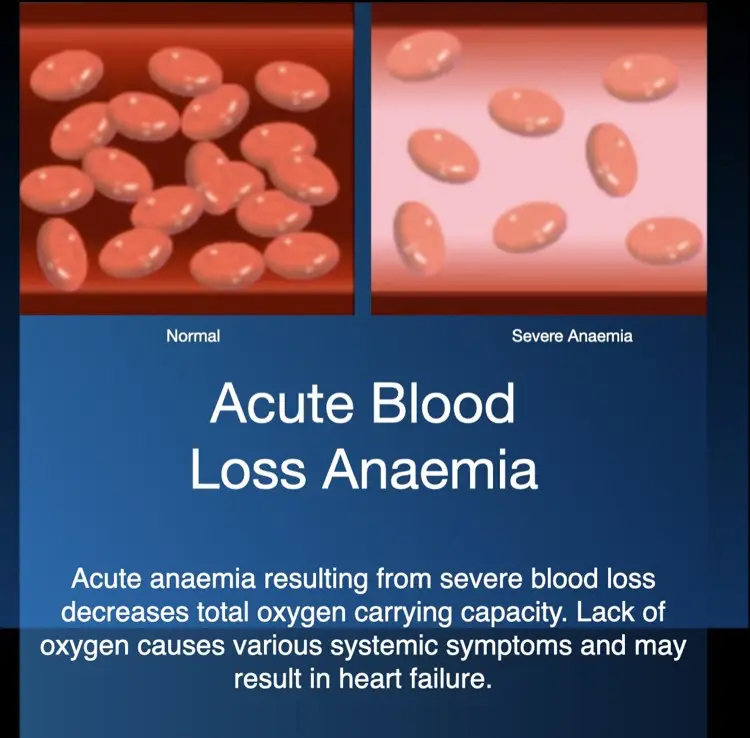
What is severe blood-loss anaemia?
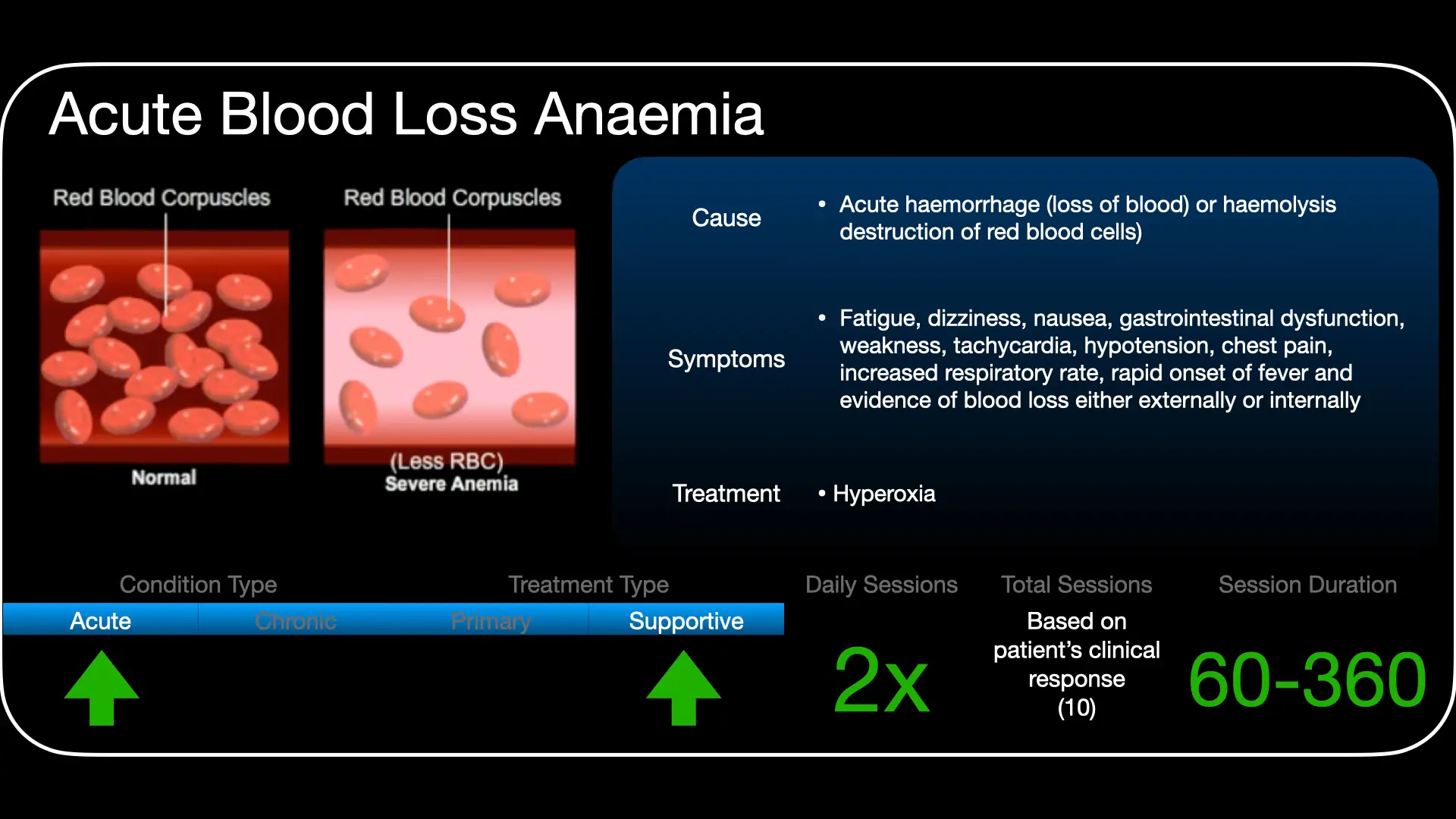
Red blood cells carry oxygen from your lungs to every organ. After heavy bleeding - from a serious injury, surgery, or a bleed inside the body - the number of red blood cells can fall sharply. When the blood can no longer deliver enough oxygen, this is called severe anaemia, and it can become dangerous.
How is it usually treated?
The usual treatment is a blood transfusion. Sometimes, though, a transfusion is not an option - there may be no compatible blood available in time, or you may have chosen not to receive blood for personal or religious reasons. In these situations, hyperbaric oxygen therapy can help.
How can hyperbaric oxygen help?
In the hyperbaric chamber you breathe pure oxygen while the pressure around you is gently increased. Under this pressure, a large amount of oxygen dissolves directly into the plasma - the watery part of your blood - instead of relying only on red blood cells to carry it. That dissolved oxygen can keep your organs supplied even when your red-cell count is very low.
What to expect
Treatment is given as sessions in the chamber, alongside the rest of your care - fluids, iron, medicines that boost red-cell production, and treating the cause of the bleeding. How many sessions you need, and how long each lasts, is decided for your situation. It is a temporary, supportive measure, not a cure for the underlying cause.
Is it safe?
Hyperbaric oxygen is generally well tolerated. The most common sensation is pressure on the ears during compression, much like descending in an aeroplane. Serious side effects are uncommon. You can read more on our risks and side effects page.
Watch
 For Patients: Severe Anaemia (English)
 Vir pasiënte: Ernstige Bloedarmoede (Afrikaans)
 Breathing on Borrowed Time — explainer
This page is general health information and does not replace advice from your own doctor. Whether hyperbaric oxygen is appropriate depends on your individual circumstances.
Clinical summary
Indication
Severe (exceptional blood-loss) anaemia is a recognised indication for hyperbaric oxygen (HBO) therapy under the Undersea & Hyperbaric Medical Society (UHMS). HBO is considered as adjunctive therapy where red-cell transfusion is impossible, unavailable, or declined (medical, religious, or strong personal reasons), and there is evidence of - or imminent - end-organ hypoxia despite volume resuscitation.
Physiological rationale
Oxygen delivery normally depends on haemoglobin (1.38 mL O₂ per gram). Dissolved plasma oxygen follows Henry's Law - proportional to PaO₂ at 0.003 mL O₂/dL/mmHg.
Bridging the oxygen gap
Breathing air at sea level, dissolved plasma O₂ is ≈ 0.3 mL/dL. Breathing 100% O₂ at ~3 ATA raises PaO₂ above 1,500-2,000 mmHg, dissolving ≈ 6 mL/dL in plasma - approximating the resting arteriovenous oxygen difference. Tissue oxygen demand can therefore be met largely independent of haemoglobin. Boerema's classic "Life Without Blood" experiment (1960) demonstrated survival of exsanguinated pigs at a haemoglobin near 0.4 g/dL while at 3 ATA.
Role in management
HBO is a bridge across the anaemic nadir, not a definitive therapy. It is used alongside haemorrhage control, volume resuscitation, haematinics (iron, B₁₂, folate) and erythropoiesis-stimulating agents, and is continued until endogenous red-cell mass recovers sufficiently. Because oxygen is delivered intermittently, raised tissue oxygen stores and reduced metabolic demand help bridge the intervals between sessions.
Patient selection & monitoring
- Clinical or biochemical evidence of anaemic hypoxia (e.g. rising lactate, base deficit, ECG ischaemia, altered mentation) refractory to non-transfusion measures.
- Transfusion genuinely not an option for the reasons above.
- Response titrated between sessions against symptoms, lactate/base deficit and haemoglobin trajectory.
Treatment approach
Treatment pressures in the region of 2.0-3.0 ATA are described in the literature, with the number and frequency of sessions individualised to the patient's clinical trajectory. Protocols are tailored case by case at the unit.
Evidence base
This is a rare, emergency indication, and the evidence reflects that. The rationale is well established physiologically - Boerema's classic "life without blood" experiments showed that at 3 atmospheres enough oxygen dissolves in plasma (about 6 mL per 100 mL) to meet resting needs even with almost no haemoglobin. A systematic review (Van Meter 2005) of 35 reports found all described a favourable result, and later reviews (Van Meter 2024; 2012) frame HBO as a bridge within standard resuscitation. Published cases include survival with full recovery at a haemoglobin as low as 1.9 g/dL after hyperbaric treatment when transfusion was refused.
We state the limitation plainly: there is no randomised trial, and there cannot ethically be one - you cannot randomise a patient who cannot or will not be transfused. The evidence is therefore physiological reasoning plus case reports and series, which is why the international bodies place it at a moderate/adjunctive tier. HBO is a bridge that sustains tissue oxygen while the blood count is rebuilt by other means; it does not itself correct the anaemia.
Bottom line
HBO is used only for life-threatening anaemia when transfusion is impossible, refused (for example on religious grounds), or unavailable. Delivered in intermittent sessions, it dissolves enough oxygen into plasma to keep tissues alive during the critical period while haemoglobin is restored with iron, erythropoietin, nutrition and control of bleeding. It is a temporary bridge alongside full medical management - never a substitute for transfusion in a patient who can accept it.
Talks & chapter reviews
Recorded talks and textbook-chapter reviews on this indication:
 UHMS Indications, Ch. 13 — Severe Anaemia
 Hyperbaric Medicine Practice, Ch. 27 — Exceptional Blood-Loss Anaemia
 Jain's Textbook, Ch. 26 — Haematology & Immunology
 HBOT for Acute Blood-Loss Anaemia (overview)
 HBOT in Blood-Loss Anaemia (overview)
Key references
- Undersea & Hyperbaric Medical Society. Hyperbaric Oxygen Therapy Indications, 15th ed (2023) - Severe Anemia (Exceptional Blood Loss).
- Boerema I, Meyne NG, Brummelkamp WH, et al. Life without blood. J Cardiovasc Surg. 1960;1:133-46.
- Van Meter KW. A systematic review of the application of hyperbaric oxygen in the treatment of severe anemia. Undersea Hyperb Med. 2005;32(1):61-83.
- Van Meter KW. Hyperbaric oxygen therapy in the ATLS/ACLS resuscitative management of acutely ill or severely injured patients with severe anemia: a review. Front Med (Lausanne). 2024;11:1408816. doi:10.3389/fmed.2024.1408816
- Graffeo C, Dishong W. Severe blood loss anemia in a Jehovah's Witness treated with adjunctive hyperbaric oxygen therapy. Am J Emerg Med. 2013;31(4):756.e3-4. doi:10.1016/j.ajem.2012.11.013
Life Without Blood: The High-Pressure Medical Breakthrough You've Never Heard Of
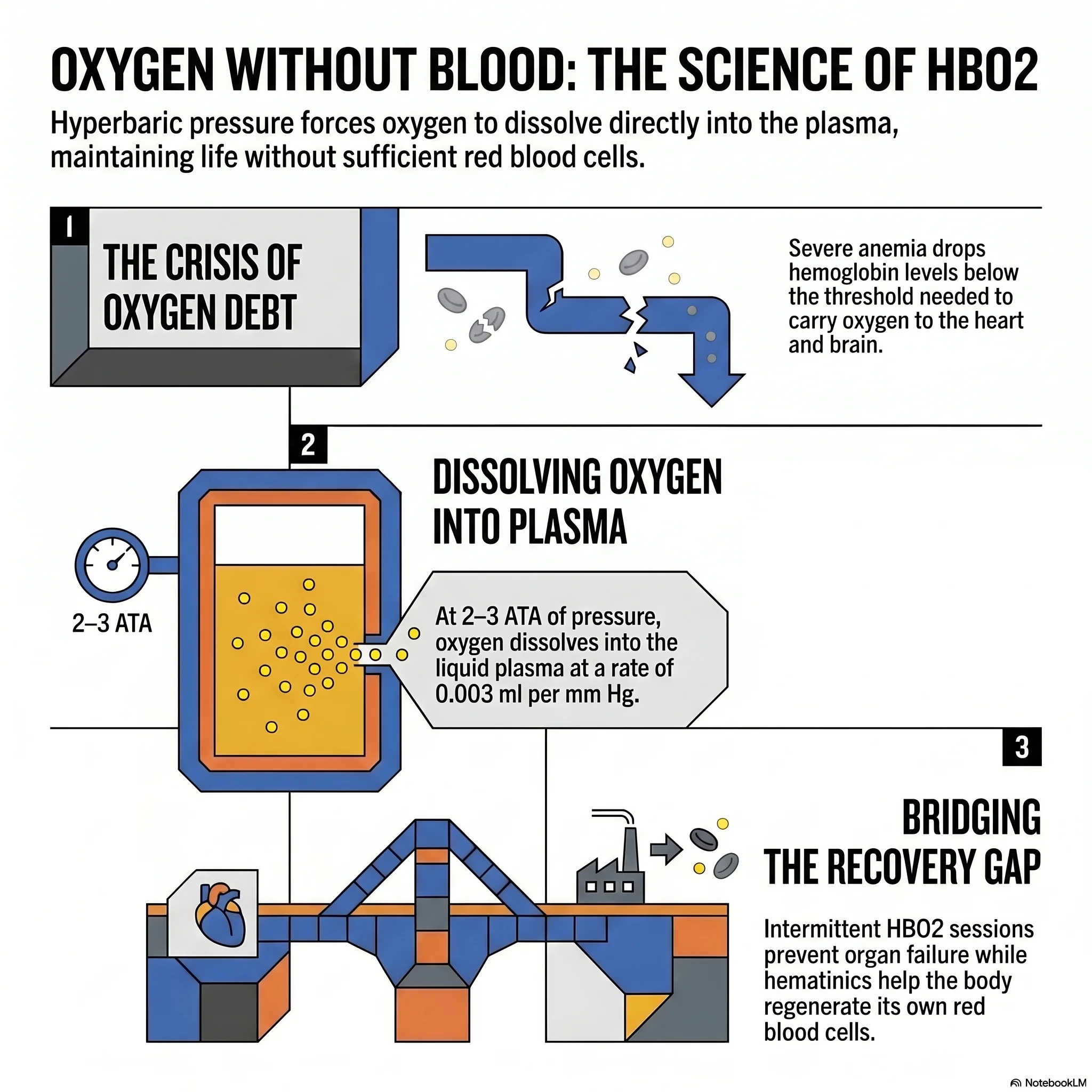
1. The high-stakes dilemma of severe anaemia
Consider the clinical precipice where a patient's haemoglobin (Hb) drops below 3.6 g/dL. At this threshold, the biological machinery of oxygen delivery is no longer just compromised - it is mathematically inadequate to sustain human life. In the standard theatre of trauma or critical care, a massive blood transfusion is the immediate reflex. However, for many, this "gold standard" is a closed door.
Whether due to religious conviction, the inability to crossmatch rare antibodies, or the logistical absence of blood products, these patients enter a lethal state of "oxygen debt." The medical challenge is profound: how do you keep a human being alive when their primary oxygen carrier is effectively missing? Hyperbaric oxygen (HBO2) therapy provides the answer, serving as a high-pressure metabolic bridge that turns the patient's entire circulatory system into a transparent delivery vehicle for life-sustaining gas.
2. Takeaway 1: bypassing haemoglobin via Henry's Law
In normal physiological conditions, we are slaves to our red blood cells. Haemoglobin is a prodigious carrier, bound to roughly 1.38 ml of oxygen per gram. In contrast, at sea level, the amount of oxygen that dissolves into the plasma is a negligible 0.003 ml of oxygen per mm Hg of partial pressure per millilitre of plasma.
HBO2 therapy utilises the elegant physics of Henry's Law to fundamentally rewrite this ratio. When a patient is placed in a pressurised chamber at 3 ATA (300 kPa) and breathes 100% oxygen, the partial pressure of oxygen in the lungs is elevated to such a degree that the plasma begins to carry the heavy load. At these pressures, the dissolved oxygen in the plasma alone approaches 6 vol% (6 ml of oxygen per 100 ml of blood). This is a critical mathematical victory; because the average human body extracts approximately 5 to 6 ml of oxygen for every 100 ml of circulating blood, HBO2 allows the plasma to meet the total metabolic demand of the tissues, rendering haemoglobin temporarily redundant.
The historical proof of this concept is startling:
"As early as 1959, Boerema demonstrated that exsanguinated swine which then were transfused with 6% dextran/dextrose/Ringers' lactate solutions to produce Hb levels of 0.4 to 0.6 g/dL could survive in the short-term if they underwent assisted oxygen ventilation in a hyperbaric chamber at 300 kPa."
3. Takeaway 2: the lethal math of "oxygen debt"
Clinicians must look beyond simple haemoglobin counts to the more predictive metric of "accumulative oxygen debt" - the time integral of the oxygen consumption (VO2) measured during shock minus the baseline requirements. However, this debt is not a static number; it is a race against time.
Research indicates that the window for intervention is narrow, with specific survival thresholds tied to the debt accumulated within the first four hours of the insult:
- 33 L/m²: at this level of accumulated debt, the statistical chance of survival is zero.
- 22 L/m²: this debt level serves as the gateway to multiorgan failure (MOF).
- 9 L/m²: patients who maintain or rectify their debt to this level generally survive without residual disability.
When patients approach these limits, the body provides loud, visceral signals of end-organ dysfunction. Severe anaemia is not just a laboratory value, but a clinical narrative of failing systems: the advent of ischaemic ECG changes, altered mental status, and the tell-tale sprue-like diarrhoea from an ischaemic bowel. HBO2 works by "repaying" this debt in real-time, arresting the slide toward multiorgan collapse.
4. Takeaway 3: HBO2 as a sanctuary for restricted patients
The clinical necessity for HBO2 often arises from the patient's exercise of medical autonomy. It serves as a vital sanctuary for three primary demographics:
- Religious autonomy: Jehovah's Witnesses who refuse blood products on theological grounds.
- Immunological complexity: patients who cannot be crossmatched due to rare antibodies or complex haemolytic histories.
- Safety and risk mitigation: despite advanced nucleic acid testing (NAT), the spectre of transfusion-transmitted infections (TTI) remains. Patients today cite risks not just of HIV and HCV, but of emerging threats like Zika, West Nile, and SARS-CoV-2.
In these contexts, HBO2 is more than a therapy; it is an ethical tool that allows physicians to respect the patient's rights while providing a scientifically rigorous bridge to recovery.
5. Takeaway 4: the hidden risks of the "gold standard"
We must reframe our view of blood transfusions. They are not simple "fluid replacements"; they are complex tissue transplantations. Massive transfusions introduce a significant "biological overhead" characterised by untoward inflammatory and immunomodulatory effects.
The clinical literature identifies several severe, often lethal, complications:
- TRALI (transfusion-related acute lung injury): the leading cause of transfusion-related mortality.
- TACO (transfusion-associated circulatory overload): a common cause of pulmonary oedema.
- TAD (transfusion-associated dyspnoea): acute respiratory distress following the infusion of donor products.
In contrast to the "dirty" biological complexity of donor blood, HBO2 is "clean" physics. A recent human trial (n=20) involving patients undergoing partial hepatectomy for liver cancer demonstrated that postoperative HBO2 significantly improved survival and diminished complications compared to a control group (n=21). The study suggested that HBO2 could successfully overcome systemic oxygen supply deficiencies while reducing the need for inflammatory erythrocyte transfusions.
6. Takeaway 5: the cost-equivalency paradox
Despite the "high-tech" aura of the hyperbaric chamber, it is remarkably cost-competitive. The wholesale price of a single HBO2 treatment is roughly equivalent to the cost of one unit of packed red blood cells.
When one weighs the minimal side-effect profile of HBO2 against the potential for lethal transfusion reactions or the long-term costs of managing TRALI or MOF, the "low-technology, cost-competitive" nature of HBO2 becomes clear. It is an underutilised resource in modern anaemia management, often missing from the medical discourse simply due to a lack of awareness rather than a lack of efficacy.
7. Conclusion: the regenerative bridge
Hyperbaric oxygen is the ultimate bridge therapy, but it does not work in isolation. The goal is to sustain life while simultaneously stimulating the body's own production of red blood cells. This is achieved through the aggressive use of haematinics (blood-building agents) and by leveraging the "normobaric oxygen paradox." Recent work has shown that even intermittent normobaric oxygen during the "off" periods between hyperbaric treatments can increase endogenous erythropoietin levels, essentially tricking the body into accelerated red cell production.
As we look toward the horizon of emergency medicine, we must ask: why is this resource restricted to the hospital basement? From "far-forward" military settings to pre-hospital EMS environments, the ability to decisively reduce oxygen debt without a single drop of donor blood represents a new frontier in trauma care. HBO2 offers a measured, science-driven alternative that stabilises the patient today so they can heal themselves tomorrow.
This feature article is general educational information and does not replace advice from your own doctor. Whether hyperbaric oxygen is appropriate depends on individual circumstances. Portions were drafted with the assistance of AI tools and reviewed by Dr Gregory Weir; please verify clinical details against primary sources.
Speak to the unit
The Vascular & Hyperbaric Unit, Life Eugene Marais Hospital, Pretoria.
Call 012 335 8651► Browse all Educational Hyperbaric Oxygen Therapy Videos
Medically reviewed by Dr Gregory Weir, vascular surgeon. Last updated July 2026.